
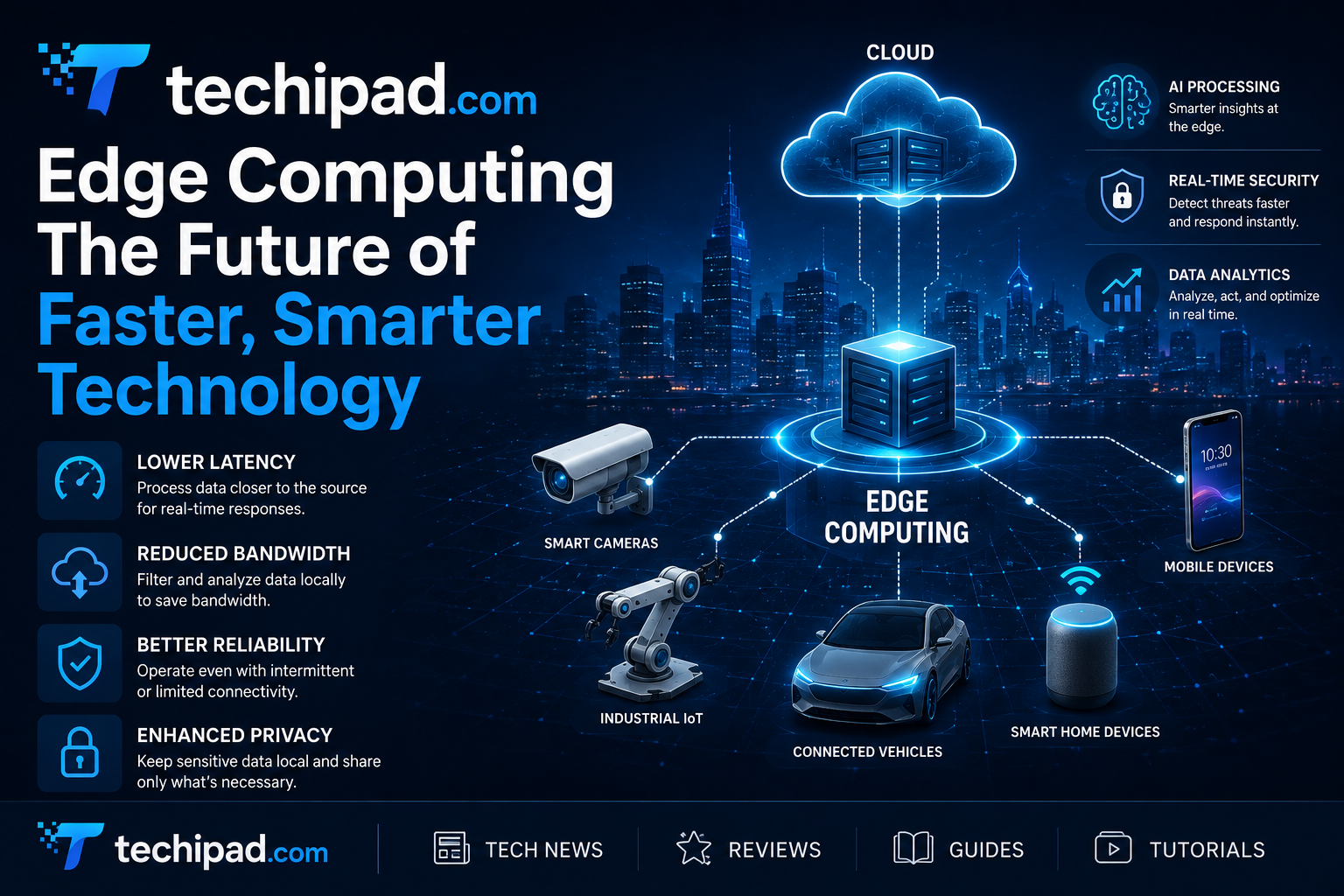
Edge computing is a technology approach that processes data closer to where it is generated instead of sending everything to a distant cloud data center. By moving some computing and storage closer to devices, edge computing can reduce delays, improve responsiveness, and help organizations handle large amounts of data more efficiently.
The concept has become increasingly important as smartphones, smart home devices, connected vehicles, industrial sensors, cameras, and other Internet of Things (IoT) devices generate more data than ever before.
Cloud computing remains an important part of modern technology, but edge computing provides another layer of infrastructure that can help applications respond faster and operate more efficiently.
What Is Edge Computing?
Edge computing is a distributed computing model in which data processing takes place near the physical location where data is produced or consumed.
In a traditional cloud-based setup, a connected device may send data to a remote data center for processing before receiving a response. With edge computing, some of that processing can happen on a nearby device, gateway, local server, or edge data center.
A simple example is a security camera.
Instead of sending every video frame to a remote server, an edge-enabled camera or nearby computing device can analyze the footage locally. It may identify whether the camera has detected a person, vehicle, or other movement and then send only the relevant information to a central system.
This approach can reduce unnecessary data transfers while allowing the system to react more quickly.
How Does Edge Computing Work?
Edge computing typically involves several layers working together.
A connected device first generates data. This could be a smartphone, camera, industrial sensor, vehicle, wearable device, or smart appliance.
That data can then be processed locally or sent to a nearby edge device. More complex tasks can still be transferred to a cloud platform or centralized data center.
The basic process can look like this:
Device → Edge Processing → Cloud or Central System
The edge layer does not necessarily replace cloud computing. Instead, the two can work together.
For example, an industrial facility could use edge computers to monitor machines in real time while sending selected information to a cloud platform for long-term analysis and reporting.
Why Is Edge Computing Important?
The main reason edge computing matters is that modern technology is generating enormous amounts of data.
Sending all of that information to centralized cloud servers can create challenges involving latency, bandwidth, reliability, and privacy.
Processing some information closer to the source can address several of these challenges.
1. Lower Latency
Latency is the time it takes for data to travel between a device and a system and for a response to return.
For applications that require rapid responses, even small delays can matter.
Autonomous and assisted-driving systems, industrial machinery, augmented reality applications, interactive gaming, and real-time monitoring can all benefit from faster processing.
With edge computing, some decisions can be made closer to the device instead of waiting for a distant server.
2. Reduced Bandwidth Usage
Connected devices can generate huge amounts of data.
Consider a network of high-resolution security cameras. Continuously sending every video frame to the cloud could consume significant bandwidth.
An edge system can analyze the video locally and transmit only important events or summarized information.
This can reduce the amount of data traveling across the network.
3. Improved Reliability
Some applications cannot depend entirely on a constant connection to a remote cloud service.
Edge computing can allow certain functions to continue operating locally when connectivity is limited or temporarily unavailable.
For example, an industrial monitoring system could continue analyzing sensor information locally even if its connection to a central cloud platform is interrupted.
The exact capabilities depend on how the system is designed, but local processing can provide an additional layer of resilience.
4. Better Data Control
Edge processing can also help organizations decide what information needs to leave a local environment.
Instead of transferring every piece of raw data to a remote platform, a system can process information locally and send only the results required for a particular application.
This does not automatically guarantee privacy or security, but it can provide organizations with more control over how data moves through their infrastructure.
How Is Edge Computing Used in Everyday Technology?
Edge computing may sound like an enterprise technology, but its applications extend into consumer technology and everyday services.
Smartphones and Mobile Devices
Modern smartphones already perform significant amounts of computing directly on the device.
Features such as camera processing, speech recognition, image enhancement, and certain AI functions can use local hardware to process information without relying entirely on cloud servers.
This can improve responsiveness and, for supported features, reduce the need to send personal information to external systems.
Smart Home Devices
Smart home systems contain a growing number of connected devices, including cameras, thermostats, doorbells, lighting systems, speakers, and sensors.
Edge processing can allow these devices to react to local conditions more quickly.
For example, a smart security camera may analyze movement locally and send an alert only when its software determines that an important event has occurred.
Connected Vehicles
Vehicles contain numerous sensors that continuously collect information about speed, surroundings, road conditions, and vehicle performance.
Some of this information needs to be processed quickly.
Edge computing can support applications that require rapid analysis by allowing certain processing tasks to take place inside the vehicle or nearby infrastructure.
Cloud systems can still be used for longer-term analytics, software updates, fleet management, and other tasks.
Industrial Technology
Manufacturing is another major area where edge computing can be valuable.
Factories can use sensors to monitor equipment, production lines, temperature, vibration, and other conditions.
An edge computer can analyze this information in real time and identify unusual patterns.
If a machine begins showing signs of a potential problem, the system may be able to notify operators or trigger an automated response before the issue becomes more serious.
What Is the Difference Between Edge Computing and Cloud Computing?
Edge computing and cloud computing are closely related, but they perform different roles.
Cloud computing generally relies on centralized data centers to provide computing power, storage, databases, and software services over a network.
Edge computing moves some of those capabilities closer to the location where data is generated or used.
Neither approach is universally better.
Cloud computing is extremely useful for large-scale storage, centralized analytics, application hosting, and processing workloads that do not require immediate local responses.
Edge computing is particularly useful when low latency, local processing, reduced bandwidth usage, or continued operation during connectivity problems is important.
In many modern systems, the best solution is a combination of both.
What Role Does AI Play in Edge Computing?
Artificial intelligence is one of the technologies helping make edge computing more useful.
AI models can analyze information generated by cameras, sensors, microphones, vehicles, and other devices.
Running AI directly or partially on edge devices can allow certain decisions to happen locally.
For example, an intelligent camera could use a machine-learning model to identify specific types of objects without continuously uploading raw video to a cloud service.
Similarly, smartphones can use specialized processors to perform certain AI tasks directly on the device.
This combination is often described as edge AI.
Edge AI can be especially useful when an application requires fast responses or when reducing the amount of sensitive data transferred to external servers is desirable.
What Are the Challenges of Edge Computing?
Despite its advantages, edge computing also introduces challenges.
Security
Increasing the number of devices that perform computing tasks can increase the number of systems that need to be protected.
Organizations must secure edge devices, networks, software, and data.
A poorly protected edge device could become an entry point for attackers.
Device Management
Managing hundreds or thousands of distributed edge devices can be more complicated than managing a centralized infrastructure.
Organizations may need systems for monitoring devices, deploying software updates, detecting failures, and maintaining hardware.
Limited Computing Resources
Edge devices may have less processing power and storage than large cloud data centers.
Developers therefore need to carefully decide which workloads should run locally and which should be transferred to centralized infrastructure.
Higher Infrastructure Complexity
A system that combines cloud services, edge servers, networks, and connected devices can be more complex to design and maintain.
Organizations need appropriate architecture, monitoring, security policies, and technical expertise.
Is Edge Computing the Future of Technology?
Edge computing is likely to remain an important part of the technology infrastructure supporting connected devices.
The growth of artificial intelligence, IoT, smart cities, connected vehicles, industrial automation, and real-time applications is increasing the need for fast and efficient data processing.
However, edge computing is unlikely to completely replace cloud computing.
Instead, future systems will increasingly combine local processing with centralized cloud infrastructure.
Devices can handle tasks that require immediate responses, while cloud platforms can provide large-scale computing, storage, analytics, and coordination.
This hybrid approach can provide the strengths of both models.
Frequently Asked Questions About Edge Computing
What is edge computing in simple terms?
Edge computing means processing data closer to where it is created instead of sending all of it to a distant cloud server. This can help applications respond faster and reduce unnecessary data transfers.
Is edge computing the same as cloud computing?
No. Cloud computing generally uses centralized data centers, while edge computing moves some processing closer to connected devices and users. Many modern systems use both technologies together.
What is edge AI?
Edge AI refers to running artificial intelligence or machine-learning workloads on edge devices or nearby computing infrastructure. This can allow certain AI-powered tasks to happen closer to where data is generated.
Does edge computing improve internet speed?
Edge computing does not necessarily make the underlying internet connection faster. Instead, it can reduce the distance data needs to travel for certain tasks, which may lower response times and reduce network traffic.
Where is edge computing used?
Edge computing can be used in smartphones, smart homes, connected vehicles, industrial facilities, security systems, healthcare technology, telecommunications, retail environments, and many other connected applications.
Conclusion
Edge computing is changing how modern technology handles data by bringing processing closer to the devices and people that need it.
Rather than relying exclusively on distant cloud servers, organizations can use edge devices and local computing infrastructure to process selected information closer to its source. This can reduce latency, save bandwidth, improve resilience, and provide more control over data flows.
From smartphones and smart homes to connected vehicles and industrial systems, edge computing is becoming increasingly relevant as the number of connected devices continues to grow.
The future is unlikely to be purely cloud-based or purely edge-based. Instead, the most capable technology platforms will combine edge computing, cloud infrastructure, artificial intelligence, and high-speed networks to create faster and more responsive digital experiences.
Leave a Reply